We are pleased to announce the release of the latest unit in the Teaching Tools in Plant Biology series, “Genomic Analysis of Botanical Collections: Opportunities and Challenges,” by Martina Deglialberti, Chiara Paleni, Federico Fainelli, Carla Lambertini, and Silvia Manrique.
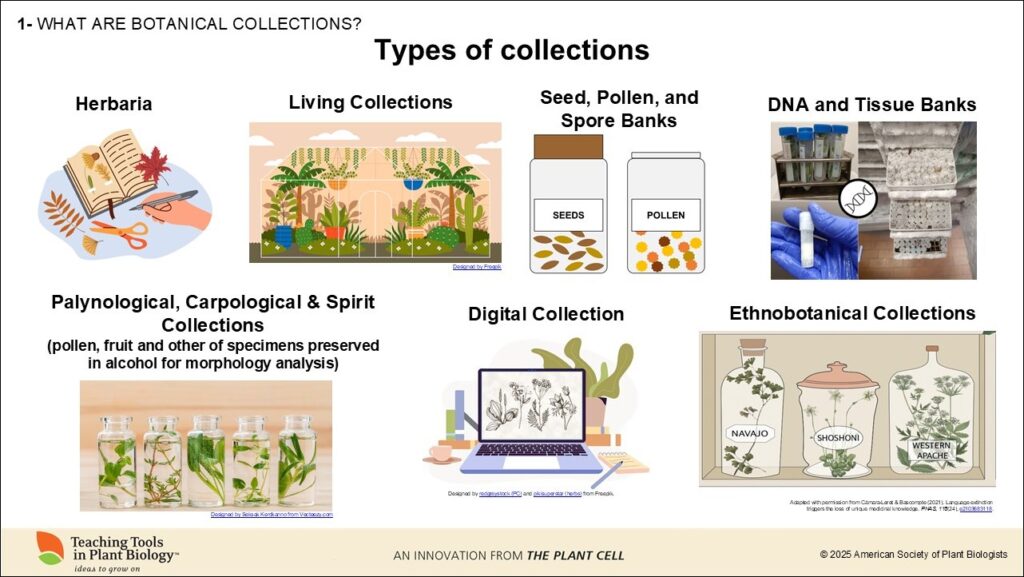 This Teaching Tools provides an overview of how botanical collections of all sorts can be used to understand plant evolution and diversity through genomic analysis.
Botanical collections, comprising living or preserved specimens, are invaluable repositories of plant biodiversity. Genomic analysis of these collections can help answer critical questions about species evolution and extinction and contribute to conservation of plant resources. However, these resources are often underutilized due to limited resources, technical difficulties or lack of awareness. In this lesson, we provide an overview of the factors influencing genomic studies of botanical collections, we introduce the challenges and solutions of plant genomics for botanical collections and stimulate reflection on innovations in establishing botanical collections for future research.
Here the authors describe their motivation for creating this Teaching Tool.
We came together a bit by chance through several undergraduate and graduate projects studying genomic diversity in wild plants. We faced our challenges in discovering genomics of wild species, but we succeeded together with trial and error. When we wrote this article, we were two researchers (Carla and Silvia) and three students at university (Martina, Chiara and Federico), and the paper was born from a combination of our different experiences, research and teaching needs, challenges we encountered, and questions we posed.
Martina’s master’s thesis focused on the challenges of genomics of wild plant species, sparked the idea of a Teaching Tools paper that could help those who find themselves studying genomics as a subject or undertaking genomics for biodiversity conservation rather than breeding. We all developed and wrote parts of the tool, and Silvia, who immediately configured the Tools approach, guided us to maintain focus and organically assembled our contributions. It was a shared process in which we all contributed text and slides and shared the excitement of getting to publication.
 Martina Deglialberti
Working on this paper made me realize how much hidden potential botanical collections hold for genomics. It was such a rich experience, both scientifically and personally, and I’m really glad to have been part of such a close and supportive team. I hope this Teaching Tool will help students and young researchers to explore the genomic dimension of plant diversity with curiosity and confidence.
 Chiara Paleni
This is the paper I wish I had when I had just started my thesis project. Putting together the bioinformatics analysis part of this Teaching Tools was a nice way to recap several steps of my PhD. I hope this lecture can be a helpful starting point for students and researchers at the beginning of their journey with bioinformatics applied to botanical research.
 Federico Fainelli
The natural world is so magnificently complex that it never ceases to surprise us. Sometimes it can feel overwhelming, but with a little preparation and curiosity, it becomes truly fascinating. This paper is the result of a collaboration with fantastic people who supported me through the many challenges I encountered during my studies. As they helped me, I truly believe this Teaching Tool can assist new students in approaching the intricate but amazing topics of plant genomics and biodiversity.
 Carla Lambertini
I am the senior in the group and I teach plant ecology and evolution. When I finally got my position at the University of Milan I had to replace genetics with genomics in my research. This was possible thanks to the help and perseverance of these guys. This teaching tool is one of the publications I am most proud of and I can’t wait for the final publication in the journal to finally deliver this lecture and all the nice material that was produced to my classes.
 Silvia Manrique
My career initially focused entirely on plant molecular biology but, over time, biodiversity genomics started to “infiltrate” my research, until it eventually became one of its pillars. I think the true turning point was my time as a postdoc in Carla’s lab, where I also met Martina, Chiara, and Federico. We all came from different backgrounds, forming a wonderfully multidisciplinary team able to approach projects that none of us could have done alone. Although we only worked together for a short time, we became a very closely knit group, and this paper is both the perfect outcome and the perfect reflection of that spirit. I genuinely believe it will be a valuable resource for anyone entering the field of plant biodiversity genomics.
Download this resource here. This is article number 45 in the Teaching Tools in Plant Biology series. You can find all of the Teaching Tools in Plant Biology articles here.