
ASPB President
Greetings ASPB community! I know that 2025 was both disruptive and consequential for many of you. I am thankful for the many ASPB members that worked together to help mitigate the negative impacts for our community. As we enter 2026, there are many exciting things on the horizon for ASPB to look forward to. A few of these are summarized below.
Our founding journal, Plant Physiology, celebrates its 100th year of publishing impactful research by our members. Look out for special Centennial programming at the Plant Biology 2026 meeting in Ottawa and say happy birthday to Plant Physiology with a birthday greeting . And check out the journal’s most-cited article ever by Daniel Arnon entitled “Copper Enzymes in Isolated Chloroplasts. Polyphenoloxidase in Beta Vulgaris”, 24(1), January 1949. This paper has been cited a remarkable 20,696 times, and with 12% of these citations coming in the last two years, it has had remarkable staying power! In addition, the search for a new Editor-in-Chief for Plant Physiology is in the final stages, and we hope to name a new EIC in the near future to lead the journal into the next 100 years!
Nominations for 2026 ASPB awards were opened in mid-December. The deadline to receive nominations is February 13, 2026, so please prepare and submit your nominations as soon as possible. This year, nominations are sought for 13 awards (https://aspb.org/awards-funding/aspb-awards/). Nominations should be submitted online and need to be made by an ASPB member. Check the details regarding the features of each award and any eligibility requirements and nominate a deserving colleague today!
Most of the regional ASPB Sections are planning their meetings for spring. The Southern section will meet March 13-15, 2026, at the University of Louisiana, Lafayette. The Western section is scheduled for April 22, 2026, at the University of California, Berkeley (joint with the Bay Area Plant Hub). The Midwest Section will meet April 24 – 26, 2026, at the University of Missouri. (Joint with Interdisciplinary Plant Group). The Northeast section will meet April 25 – 26, 2026, at the College of New Jersey. And the Mid-Atlantic section will meet May 27 – 28, 2026, at the University of Maryland, College Park. (Joint with UMD Plant Symposium)
ASPB Committees began their work for the current governance year in October of 2025. These committees and their members are engaged in wide-ranging activities to support our ASPB community. A few committee highlights follow (apologies to those not mentioned here; they will receive attention in the near future!). And please consider volunteering for an ASPB committee in service of your community. Just click this link and follow the instructions: https://members.aspb.org/s/form?id=a0S5w00000a1mym

The ASPB program committee is working tirelessly to assemble exciting key elements for Plant Biology 2026, our annual ASPB meeting that will be held this year jointly with the Canadian Society of Plant Biologists (CSPB) in Ottawa, Canada, July 18-22, 2026. This year’s meeting will feature five plenary symposia that will be live-streamed as part of an expanded Plant Biology Virtual footprint that will feature more virtual content, both before and after the in-person . Check out the meeting website for registration information (https://plantbiology.aspb.org/), and make plans to join us in Ottawa this summer. The deadline for Early Bird registration for Plant Biology 2026 is April 14, 2026.
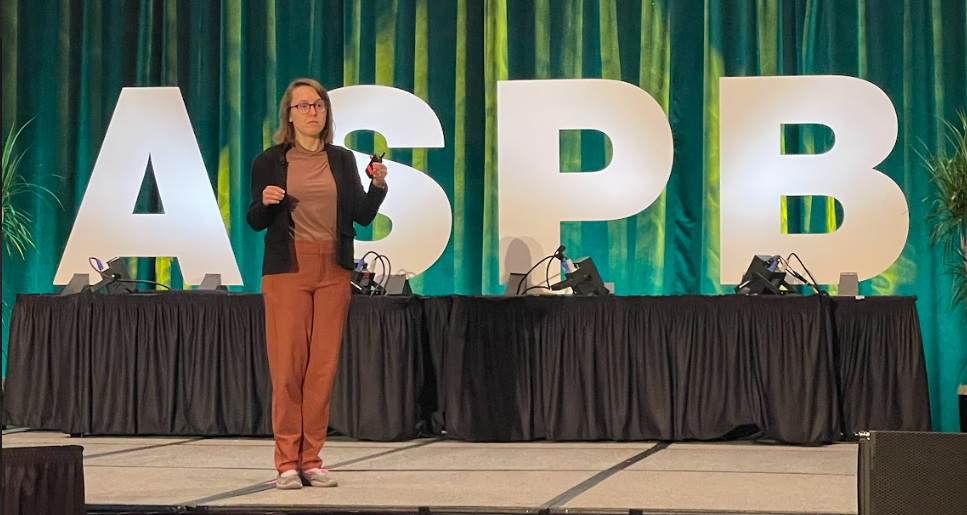
The Early Career Plant Scientists (ECPS) Section members are busy setting up webinars for a wide variety of topics including “science communication”, “what I wish I had known before graduate school”, “what I wish I had known before postdoc” and “getting prepared for your first conference”. Beyond these webinars, they are exploring new ways to bolster the community of early career scientists. For Plant Biology 2026, ECPS is working on a workshop. Additionally, they are planning for the 3MT® competition, QR quest, trivia, headshot booth, and providing travel support to early career scientists (ECRs) at Plant Biology 2026.
The ASPB International Committee (IC) has many efforts underway. IC members, Patricia Leon and Gabriel Toledo-Ortiz, co-organized the “Crops of the future” workshop on October 20, 2025, in Merida, Mexico, funded by the Templeton Foundation. Several IC members also attended the ASPB Mexico Section meeting jointly held with the Mexican Society for Biochemistry. Further, the IC is working to expand the ASPB- JSPP collaboration and has organized a symposium to be held at the JSPP meeting in Tokyo, March 13-15, 2026. Through our MOU with the JSPP, any ASPB members wishing to attend this meeting may register at JSPP member rates. Follow the link from https://jspp.org/annualmeeting/67/en_registration.html and be prepared to enter your ASPB Member ID when completing the registration form. . Cooperative interactions are also in place with our sibling society in India, and we are working on additional agreements with societies in Spain, Australia, and Taiwan.
The Membership Committee (MemComm) will hold a workshop at the Plant Biology 2026 meeting entitled “Explore Plant Science Careers and Grow Your Network”. Some revisions and updates were made to the ASPB Ambassador program in support of the ASPB mission, and a call for new ambassadors concluded . And with support from the MemComm members, ASPB staff launched membership refresh campaign, which is designed to target the lapsed members and other contacts in ASPB’s contact database. The recently concluded 1st phase of the campaign garnered 300 members, which corresponds to an impressive 15% growth in ASPB’s membership base!
In other efforts, ASPB governance and staff, collectively, have developed a strategic plan that will help guide our society through these challenging times, placing services for our membership at the heart of its priorities. As part of this strategic plan, a “360-degree” organizational review of ASPB will be conducted with a focus on how to prioritize member services, to improve organizational efficiencies, and to solidify our financial position. In support of this effort, please be on the lookout to offer your opinions of how ASPB might best serve your professional needs.
So, there are myriad ways in which ASPB is carrying out our mission “to promote plant science and plant scientists”. I wish you a productive start to your 2026, and remember that as members of our professional society, we are stronger together.

Appreciate the details, helpful for planning engagement with ASPB events.