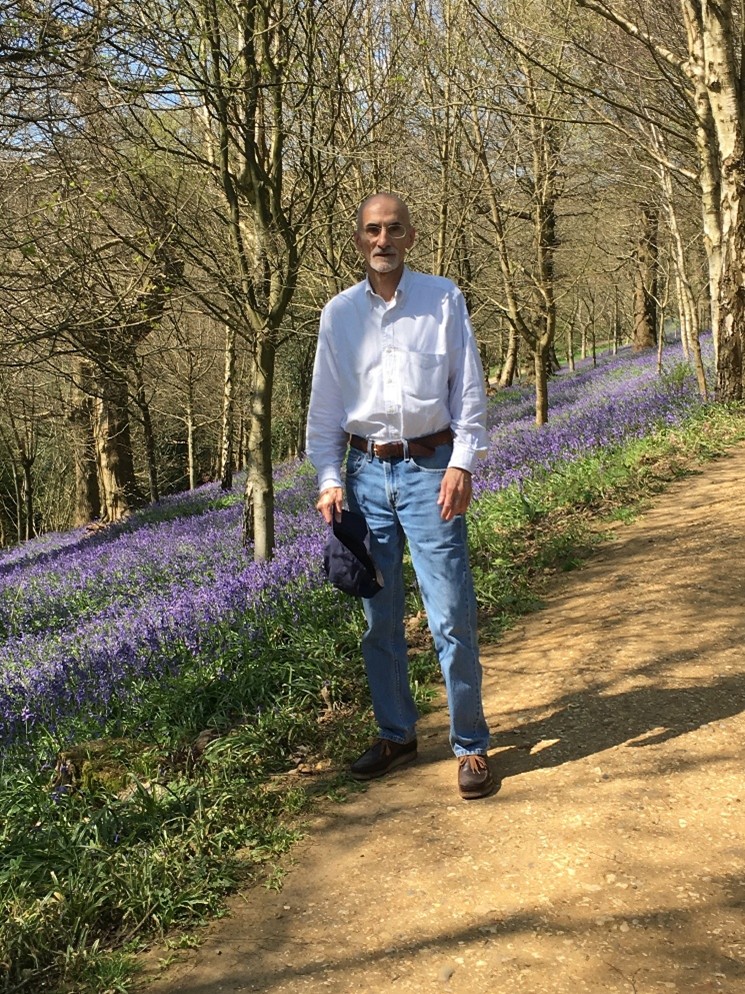
The plant biology community worldwide will be missing a visionary leader.
Dr. Andrew Hanson was C.V. Griffin Sr. Eminent Scholar in the Horticultural Sciences Department at the University of Florida, Institute of Food and Agricultural Sciences since 1994. His B.Sc. in Biochemistry and Botany and his Ph.D. in Plant Physiology, supervised by Prof. Jack Edelman (1927-2011), were from Queen Elizabeth College, University of London, U.K. After a period working on cereal seed vigor at Rank Hovis McDougall Ltd., he received postdoctoral training in plant biochemistry and metabolism at the Université d’Aix-Marseille and the MSU-DOE Plant Research Laboratory (PRL) at Michigan State University, supervised by Dr. Claude Péaud-Lenoël (1918-2016) and Prof. Hans Kende (1937-2006), respectively. He then became a faculty member at the PRL, jointly appointed in the Department of Plant, Soil and Microbial Sciences. He moved to the Institut de Recherche en Biologie Végétale of the Université de Montréal as a Professeur Titulaire in 1991, before joining the University of Florida, Gainesville in 1994. He was a fellow of the American Association for the Advancement of Science, and was elected to the US National Academy of Sciences in 2024, one of the highest honors for a scientist.
Andrew Hanson’s contributions to plant biology are extraordinary, unique and multifaceted. During the last two decades, he emerged as a leader in plant synthetic biology by providing young minds with the vision, guidance and training to realize this domain’s potential to design new life processes and repurpose existing natural ones for useful ends (Joshi and Hanson, 2024). His research on directed evolution of enzymes provided answers to many biochemical puzzles related to pathways critical for the biosynthesis of vitamins. Andrew Hanson focused his attention on how science-based knowledge can improve our food system, nutrition and health with minimal damage to our environment. He loved to communicate his ideas on these topics via multiple forums including classroom presentations, conferences and social media. He spoke and wrote about some of the most difficult global issues with clarity, nuance and humor, with a positive focus on solutions. In 2023 he was instrumental in organizing a lecture series at the University of Florida, entitled ‘Big Issues Seminar Series’, by bringing together experts from Engineering, Clinical Medicine, Nutritional Sciences and Horticulture to brainstorm ideas to solve some of the most pressing challenges in food production and human health. His work has shown that some of the health crises of nations, such as diabetes and obesity, can be solved by judicial promotion of sustainable production and consumption of vegetables and fruits (Gunter et al., 2025).
His pioneering research into understanding folate synthesis and metabolism in plants has not only informed us of the intricacies on how folates are made and used in plants and microbes but also provided tools to improve crops for their nutritional value. Folate deficiency is a global health problem. Biofortification, addition of micronutrients into food via genetic methods, is the sustainable solution to this problem. Andrew Hanson’s research made folate biofortification a reality today (Díaz de la Garza et al., 2007).
His research clarified the roles of enzymes involved in folate biosynthesis and transporter proteins. To solve the steps in the complex network of pathways in folate synthesis and metabolism, he used comparative genomics data in prokaryotes in an ingenious way to identify the steps in folate pathway in eukaryotes. This comparative functional genomics work is an exemplary demonstration for the use of the enormous amount of genome sequence data for solving fundamental plant biochemistry problems. In recent years, his research has delved into the complexity of thiamine biosynthesis and its far-reaching implications for food security and the bioeconomy, combining traditional comparative genomics with continuous directed evolution to improve enzymes for plant applications (García-García et al., 2022; Oliveira-Filho et al., 2023). This work is yet another example of how Andrew Hanson’s research has been consistently shaped by his deep insight into comparative biology and evolutionary principles.
Andrew Hanson has contributed to the world of stress physiology by exploring the role of compounds in plants that are important for plant adaptation to stress. He has identified several osmoprotectants in plant taxa that were systematically collected all over the world. He has identified the synthetic pathways leading up to these compounds, using a great mix of organic chemistry, biochemistry and stress physiology research. His work into metabolic engineering of these pathways has opened new details on how precursor pools and metabolic controls on specific enzymes could be challenging metabolic engineering attempts.
Andrew Hanson recognized the disconnects between molecular plant sciences and applied agriculture and educated the scientific community about not ‘overclaiming’ and ‘overselling’. In early 2025, he led a workshop on “How synthetic biology (SynBio) can *realistically* impact crop improvement and agriculture” (with his asterisks for emphasis), which connected 40 early career researchers with experts from industry and academia to discuss how we can build a better future (Khaipho-Burch et al., 2025). His research publications are exemplary both in substance and style. It was a delight to attend his presentations and classroom teaching. He connected with the audience easily and effectively especially via using animations to present complex biochemistry in a captivating way. Andrew held a high view of graduate education and designed engaging activities for a new SynBio class that had students work in teams to evaluate real problems and biotechnology start-ups.
Anyone talking to him would immediately notice his enthusiasm for science, thoroughness, work ethics and immense intellectual curiosity. His one-on-one meetings with trainees were filled with constructive feedback, genuine admiration, and thoughtful guidance for the future—often ending with his signature phrase, “Onwards and upwards’. It was a privilege to work with him because he instilled in his students and trainees problem-solving skills using fundamental principles. He trained numerous post-doctoral and Ph.D. students of diverse nationalities, who joined his team from various parts of the world and went on to shine in plant metabolic biochemistry research, teaching and administration across the globe. For all his accomplishments, Andrew Hanson was a humble and unassuming person. Those who knew him appreciate his kindness, compassion, generosity, his proficiency and command in English, French and Spanish and a great sense of humor.
Andrew Hanson was a proud, long-time member of the American Society of Plant Biologists (ASPB) and the Crop Science Society of America. He was awarded the ASPB Charles Reid Barnes Life Membership Award in 2012, became a Founding Legacy Society member in 2017, participated in many ASPB conferences and webinars over the years, including as chair of the inaugural ASPB Plant Synthetic Biology meeting (2019). He provided leadership to the scientific community as Chair or Vice Chair for Gordon Research Conferences on Salinity and Osmotic Stress in Plant (1996), and Plant Metabolic Engineering (2015). He served on the advisory board of The Plant Journal (2002-2007) and was a member of the editorial board of Metabolic Engineering (2002-2010) and more recently as the Associate Editor for Plant Physiology.
His research was steadily funded by the National Science Foundation, the US Department of Energy, the US Department of Agriculture, and the Natural Sciences and Engineering Research Council of Canada. He served on numerous grant panels for these agencies. These indicate confidence in his innovation by his peers. As colleagues in different settings, we also witnessed Andrew reach out to graduate students and junior faculty members when they were in need. He led by example and was an excellent mentor who helped turn the goals of his lab members and collaborators into reality. In committees, examinations and seminars, we saw him provide the most valuable and sincere input in the most constructive way possible. In more than one occasion, when difficult decisions were to be made regarding academic and administrative matters, Andrew advocated the most rational and thoughtful advice.
A globally eminent biological scientist, Andrew was also a devout Christian with a strong reliance on rationality. Through our decades-long association, we found him becoming progressively skeptical about the ability of science and technology to answer all of life’s questions. He believed that scientists need to become more familiar with the problems of the real world and with real people, and that the world’s great religions, rightly guided, could help in both respects. He loved his outreach mission, which he communicated via Twitter and talks to the local Church community.
Andrew Hanson was devoted to his family and enjoyed time with family and friends. He is survived by his wife Dr. Claudia Lerma Hanson, son Mr. Xavier Hanson, daughter-in-law Angelina, and grandchildren Jack, Arthur and Benjamin.
As we miss him deeply, he will live in the hearts of his trainees and colleagues and through his contributions to the field of plant biology.
Bala Rathinasabapathi (Professor, University of Florida, Gainesville), Steven A. Sargent (Professor, University of Florida, Gainesville), Christopher Gunter (Professor and Chair, Horticultural Sciences, University of Florida), H. Deep Saini (President and Vice Chancellor, McGill University, Montreal, Canada), Jaya Joshi (Assistant Professor, University of British Columbia, Vancouver, Canada), Cătălin Voiniciuc (Associate Professor, University of Florida, Gainesville)
Browse some of Andrew’s many contributions to Plantae:
Gazing into the Crystal Ball: Next-Gen Careers | Plantae
Zombie Donkeys and the Modern Science Ph.D. Degree | Plantae
“What makes a paper really pioneering?” webinar
References:
Díaz de la Garza RI, Gregory JF, Hanson AD (2007) Folate biofortification of tomato fruit. Proc Natl Acad Sci 104: 4218–4222
García-García JD, Van Gelder K, Joshi J, Bathe U, Leong BJ, Bruner SD, Liu CC, Hanson AD (2022) Using continuous directed evolution to improve enzymes for plant applications. Plant Physiol 188: 971–983
Gunter CC, Treadwell DD, Resende MFR, Whitaker VM, Balmant KM, Shelnutt KP, Borum PR, Andrade JE, Goodrich-Schneider R, Bernier AV, et al (2025) Food Rx: Integrating horticulture research to improve nutrition and health. Proc Natl Acad Sci 122: e2501723122
Joshi J, Hanson AD (2024) A pilot oral history of plant synthetic biology. Plant Physiol 195: 36–47
Khaipho-Burch M, Burgess SJ, Wright RC, Temme K, Voiniciuc C, Hanson AD (2025) Editorial: How SynBio can *realistically* impact crop improvement and agriculture. Plant Physiol 198: kiaf179
Oliveira-Filho ER, Voiniciuc C, Hanson AD (2023) Adapting enzymes to improve their functionality in plants: why and how. Biochem Soc Trans 51: 1957–1966
Thank you for sharing this beautiful tribute to Dr. Andrew Hanson. His groundbreaking work in plant biology and his dedication to mentoring so many young scientists truly changed the field, and more importantly, inspired hope for a healthier, more sustainable future. The way you remember his passion, kindness and vision resonates deeply. Rest in peace, and may his legacy continue to grow.
Thank you for sharing this tribute, Jayson.