 The application period is now closed! Keep your eyes open for the next opportunity to join the AFE program, sometime in 2027.
Thank you and best wishes to all applicants.
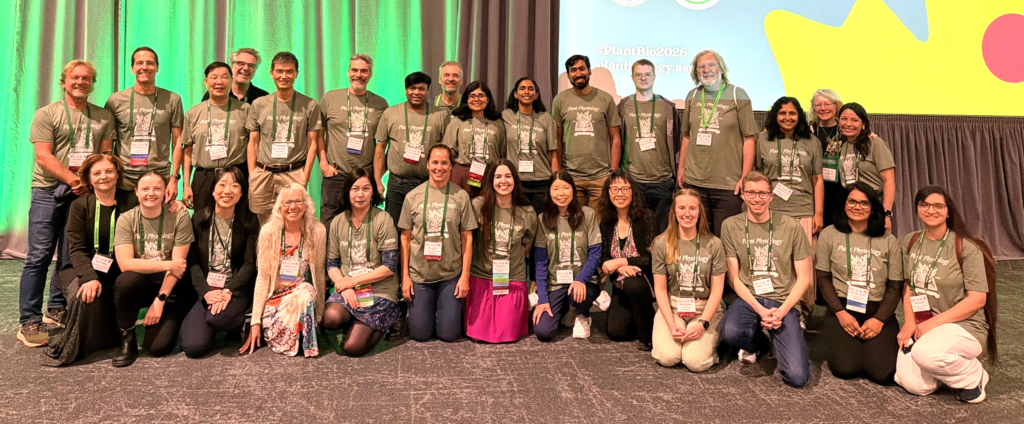
Since 2018, Plant Physiology has welcomed more than 100 early-career scientists to participate in the AFE program. Feedback from AFEs consistently reports on the positive influence the program has had on their careers in science and publishing.
You will support the journal by writing News and Views articles about recently published papers and by hosting Plant Physiology webinars on recent research. You will also be included in efforts to explore ways to make our papers more discoverable and accessible to the public.
If you are interested in becoming an Assistant Features Editor, we are welcoming applications through Tuesday, September 8, 2026.
We are interested in hearing about your current position and future goals and why you are interested in the position. We will need your Curriculum Vitae and the contact details of two individuals familiar with your work as a researcher. We will also expect two samples of your writing, one a first authored paper, and the other a sample News & Views commentary you write on your selection of one of the Plant Physiology articles listed below. We hope to have selected the new Assistant Features Editors by late in October 2026.
This program is designed to help early-career scientists develop their writing skills, and as such we ask that applicants do not use natural language processing tools driven by artificial intelligence (such as ChatGPT) in preparing their application materials. Furthermore, the cover letter should be written intentionally, providing information about you as a scientist and your motivation for applying for this program. Applications with generic cover letters or cover letters that merely repeat text from this application call are unlikely to be successful.
Send your application to PPAFEapplications@aspb.org with Plant Physiology AFE application as the subject. These materials should include
- Cover letter including preferred start date (January 2027 or January 2028)
- CV
- First-authored paper
- Contact information for two referees (we will solicit references only for short-listed candidates)
- Sample News and Views*, on one of the papers listed below. Please email Mary Williams mwilliams@aspb.org if you have difficulty accessing the paper you would like to write about.
Please include a “News and Views” style article highlighting one of the papers listed below with your application materials.
- Regulatory plasticity balances photosynthetic electron flow with enhanced pH-dependent cytochrome b6f control
- High-resolution microCT reveals relationships between stomata and interior leaf anatomy in Sorghum
- Functional divergence and symbiotic significance of nitrate reductase isoforms in Medicago truncatula
- Conserved and lineage-specific roles of KEA-mediated ion homeostasis in Chlamydomonas
- A bHLH-mediated misexpression of SPL/NZZ underpins the anther developmental arrest of female flowers in sex differentiation in monoecious litchi
- Partial coordination of leaf water relations with the leaf economics spectrum across diverse forest types
- Molecular insights into Trx system genes identified role of miR6427-5p-PagCDPS32 module in poplar under drought stress
- A hickory lysophosphatidic acid acyltransferase confers tolerance to multiple abiotic stresses via membrane lipid modulation
- Systems-level proteomic models of cotton fiber development: A high-resolution data resource to analyze cell dynamics and trait engineering
- Rhizoplane microbiome: niche-specific recruitment and plant defense priming against bacterial wilt disease
* News and Views articles are intended to provide readers with a brief summary of the main findings of a recent research article, along with relevant and interesting background information and a brief commentary on why the findings are important. The text is limited to approx. 800-1000 words and a maximum of 10 references (including the highlighted paper). The News and Views articles may be accompanied by an image, for example a panel from an image in the paper or a diagram you prepare that summarizes the key findings. You may wish to read examples of published News and Views articles to familiarize yourself with the style and format. Good examples can be found in any recent issue of the journal, e.g., https://academic.oup.com/plphys/issue#2590919-8653375.
I have a number of articles in Egypt and prefer to participate in “News and Opinions” to provide readers with a brief summary of the most important results of recent research without financial compensation.
Please feel free to apply to the program! Read the instructions for how to apply carefully – we require a sample News and Views written on one of the papers listed. Good luck!
What is the salary of an AFE ?
Is the AFE program limited to early career scientists?
Is there a program for senior scientists?
Thank you in advance.
Diego Hojsgaard
Hi Diego, The program is designed for post docs or late-stage PhD students to help them build their CV and skills to move on to their next career stage. You might look into the Plantae Fellows program, which is open to all career stages https://plantae.org/2027fellowsapp/.
Hey William I am a M.Phil Botany scholar and want to become a part of this association.